
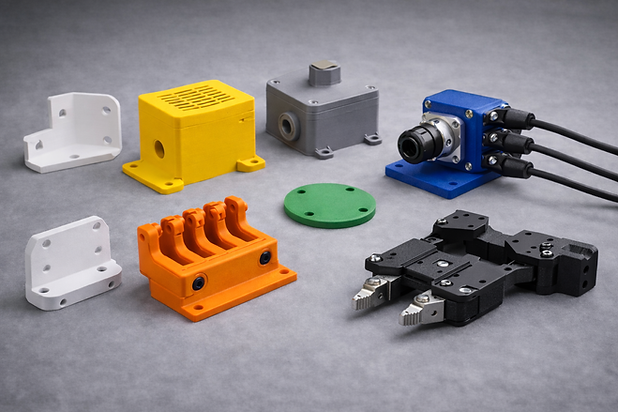
Why Choose PLA?
PLA is a widely used FDM thermoplastic ideal for concept models, form-and-fit testing, fixtures, housings, and non-load-bearing components where dimensional accuracy and visual quality are critical.
In controlled indoor environments, PLA can also be used for light-duty end-use parts, including covers, organizers, and consumer-facing components that do not require elevated temperature or high mechanical resistance.
3D printing technology
Maximum print size
256 × 256 × 256 mm (10.1" × 10.1" × 10.1")


PLA offers predictable print behavior and excellent surface resolution, supporting fast design iteration and reliable part reproduction. Its consistency makes it well suited for assembly verification, presentation models, light-duty fixtures, and short-run functional components.
PLA is commonly used throughout early and mid-stage development, allowing teams to validate geometry, ergonomics, and assembly before transitioning to higher-performance materials for load-bearing, high-temperature, or long-term service applications.
Key Benefits
-
Fast, cost-efficient production – Enables quick turnaround for development and internal use
-
High dimensional accuracy – Maintains reliable geometry for fit and assembly checks
-
Clean, consistent surface finish – Suitable for visual review and presentation
-
Predictable print performance – Supports repeatable results across multiple builds
Applications
-
Concept and presentation models – Visual parts for design reviews, client approvals, and demonstrations
-
Fit, form, and assembly validation – Checking clearances, interfaces, and part alignment
-
Light-duty fixtures and guides – Assembly aids and positioning tools for internal workflows
-
Test and evaluation components – Parts used during product development and refinement


Need a custom color or multi-color part? Contact our team or include details in your quote request to discuss available options.
Technical Specifications
Density
1.24 g/cm³
Tensile Strength
35 MPa (X–Y) | 31 MPa (Z)
5,076 psi (X–Y) | 4,496 psi (Z)
Tensile Modulus (Young’s Modulus)
2,580 MPa (X–Y) | 2,060 MPa (Z)
374 ksi (X–Y) | 299 ksi (Z)
Elongation at Break
12.2 % (X–Y) | 7.5 % (Z)
Flexural Strength
76 MPa (X–Y) | 59 MPa (Z)
11,023 psi (X–Y) | 8,557 psi (Z)
Flexural Modulus
2,750 MPa (X–Y) | 2,370 MPa (Z)
399 ksi (X–Y) | 344 ksi (Z)
Impact Strength (Notched Izod)
26.6 kJ/m² (X–Y) | 13.8 kJ/m² (Z)
Heat Deflection Temperature (HDT)
54 °C (129 °F) @ 1.8 MPa
57 °C (135 °F) @ 0.45 MPa
Vicat Softening Temperature
57 °C (135 °F)
Water Absorption (Saturated, 25 °C / 55% RH)
0.43 %
Note: Mechanical properties may vary depending on print orientation, processing parameters, and part geometry. Values are provided for design reference only.

Produce durable, cost-effective parts using Fused Deposition Modeling (FDM). Known for its versatility and broad material selection, FDM is well suited for functional prototypes, fixtures, and low-volume components where strength, speed, and efficiency matter.
Design Guidelines
Minimum wall thickness
≥ 1.0 mm
Unsupported overhangs
≤ 45° from horizontal
Bridge length
≤ 5 mm for best results
Clearance (moving parts)
≥ 0.5 mm
Load orientation
Design loads along the X–Y plane
*Recommendations vary based on geometry and application. For full details, see the full FDM design guide.
Note: Print orientation can affect part strength and performance. If your application requires a specific orientation, please include this in the quote notes or reach out to our design team for support.
