
Robotics and 3D Printing in Modern Manufacturing
Updated: Jul 8


Robotics is an ever-growing part of our lives, integrating into everything from food delivery to space exploration. Robots originally designed for simple or repetitive tasks are becoming increasingly articulate and versatile, opening the door to them being more than just tools for automation. The constant improvement in hardware, coupled with advances in software and
the integration of complex AI systems, has opened the door to processes that were previously impossible - including the fusion of robotics and 3D Printing to create smarter, more adaptable manufacturing solutions.
Robotics In Industry

When looking at the impact of robotics on society, you will find no shortage of examples in manufacturing, where it has been a staple of car assembly since 1962. Since the inception of robotic arms in 1961, there have been several technological leaps in hardware that have expanded their capabilities to those we see today. Notable achievements include achieving six degrees of freedom in 1969 and integrating embedded microprocessors in 1974, which led to a boom in the adoption of these automated systems. In recent years, robotic software has begun to catch up to and even surpass the capabilities of its hardware, greatly improving safety, versatility and even enabling new forms of manufacturing particularly through the integration of robotics and 3D printing.
How Robotics and 3D Printing Work Together
Although they are constantly improving their generalist capabilities, robots remain primarily specialized tools. As their use broadens and adoption becomes more widespread, robots will encounter tasks for which they are not specialized with increasing frequency. Users who encounter these unexpected challenges will likely look for ways to customize their robots to better circumvent them. 3D printing stands to be a viable solution. Whether it be for prototyping new models or fabricating end-use parts, the versatility of additive manufacturing aligns perfectly with the diverse, ever-evolving nature of robotics.
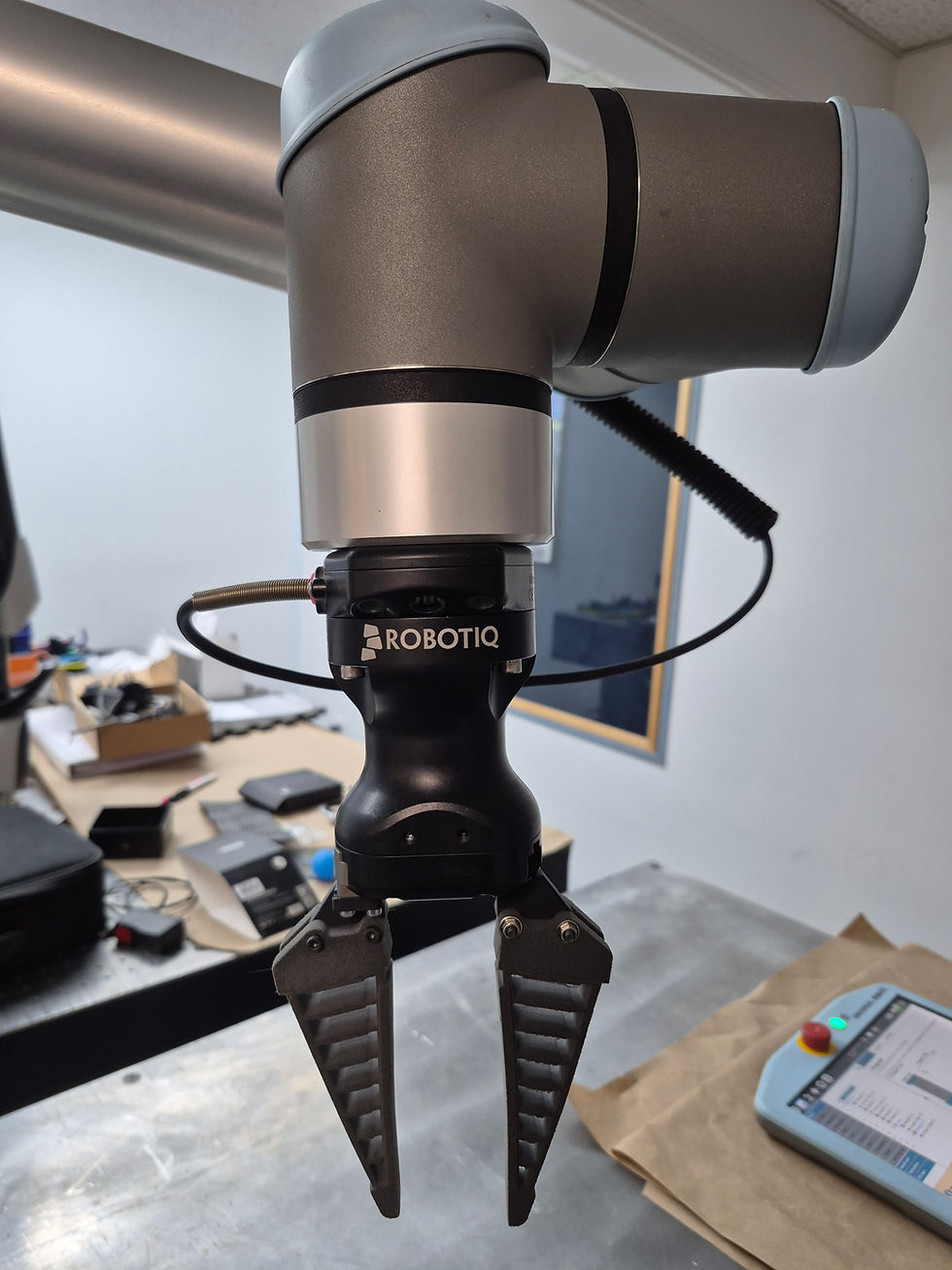
We can find a great example of this partnership in action right here at Tempus HQ. Members of the Selkirk Technology Access Centre (STAC) have recently been experimenting with multiple robot models and have identified a need for new end effectors to diversify their robots' capabilities. For their new end effector, they decided to go with Thermoplastic Polyurethane(TPU). With its non-abrasive and flexible nature, TPU end effectors can adapt to the shape of their load and interact with sensitive surfaces with minimal risk.
Robotics and 3D Printing in Industrial Applications
The relationship between robotics and 3D printing is not one-sided; robotic arms are also transforming industrial additive manufacturing. Robotic arms are enabling certain types of printing, such as FDM, to be functional in a much wider range of environments, as well as to print in ways previously impossible. The use of robotic arms in FDM gives the print head 6 degrees of freedom, which when paired with adjustable print beds, allows for supportless FDM prints, saving time and materials. Another benefit of using robotic arms is their compactness and portability compared to gantry systems. The increased portability enables printing technologies, such as Fused Deposition Modelling(FDM), Wire Arc Additive Manufacturing(WAAM), Directed Energy Deposition(DED), and concrete layered extrusion, to be deployed for on-site construction and repairs without the massive setup required for a gantry system.


Tempus 3D is an HP Certified industrial 3D printing company based in British Columbia, Canada, providing additive manufacturing solutions from rapid prototyping to production ready parts.
We offer Multi Jet Fusion (MJF), Selective Laser Sintering (SLS), Stereolithography (SLA), and Fused Deposition Modeling (FDM) to meet a wide range of production needs.
Have a project in mind? Contact us at info@tempus3d.com or request an online quote to see how Tempus 3D can support your next project.
Let's make it possible!


Comments